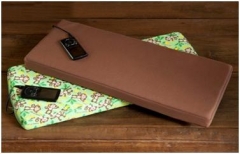
Just received an email about a new sleep product from iLs that helps with auditory sensitivity. It is priced at $295 and available for purchase by parents. It is described as follows:
The iLs Pillow delivers processed music through a vibration which is carried by the body (our bones are great conductors). The music travels internally to the bony area surrounding the inner ear, and is audible only by the user. It is used to de-senstitize those with auditory sensitivity, reduce anxiety and improve sleep.
The art and science of keeping children with autism, ADHD and sensory disorders on task.
Showing posts with label Sleep. Show all posts
Thursday, November 1, 2012
Monday, February 27, 2012
Sleep and Dental for Autism
Autism Speaks has published two guides that parents will want to download.
The first covers sleep habits and discusses bedtime routine (including sample PEX-style cards), sensory concerns (light, sound, tactile and temperature), the amount of sleep needed (children with autism appear to need less sleep), and strategies for problem sleepers. There is a wealth of good information in 8 pages. Autism Speaks Sleep Tips
The second guide is a toolkit for dental professionals. It provides practical strategies for doing dental work on children with autism. Included topics are sensory strategies, picture schedules and social stories. There are handouts for dental workers to provide to parents regarding chemicals and procedures. The appendix contains parent medical checklists and parent handouts regarding the nature of amalgams and flouride. Autism Speaks Dental Tool Kit
The first covers sleep habits and discusses bedtime routine (including sample PEX-style cards), sensory concerns (light, sound, tactile and temperature), the amount of sleep needed (children with autism appear to need less sleep), and strategies for problem sleepers. There is a wealth of good information in 8 pages. Autism Speaks Sleep Tips
The second guide is a toolkit for dental professionals. It provides practical strategies for doing dental work on children with autism. Included topics are sensory strategies, picture schedules and social stories. There are handouts for dental workers to provide to parents regarding chemicals and procedures. The appendix contains parent medical checklists and parent handouts regarding the nature of amalgams and flouride. Autism Speaks Dental Tool Kit
Wednesday, February 15, 2012
Update on Winter Depression and Melatonin and Lights
Two years ago I wrote about using low dose melatonin to help chase the winter blues. (See that post here.) There is a bit of an art to this method. Someone told me that you are supposed to use the melatonin for a few weeks in the autumn and then stop. I looked for a reference to cite on this, but found none. However, it made sense to me, so I decided to try it this year.
Starting in early November, I took about 3 drops of liquid 25 mg. melatonin in a glass of water (also tried under the tongue, which seemed to be fine, too) once a day for about 3 weeks. Research shows that there are two times of the day it will work. For most people, the dose is to be taken in the early afternoon. For others (that's me), it is taken in the morning. I would get up at 7:00 and take the melatonin at 9:00.
I did nothing else until early January when the light was beginning to increase a tad. At that time, I started getting a bit of brain fog, so I purchased a 10,000 lumen light and began sitting with it for 15 minutes in the morning. It has worked very well. I notice that my brain goes into a bit of hibernation if I miss a few days running, but otherwise, the brain is working well. BYW, I have tried using lights without melatonin in past years, but it didn't seem to be enough. And the article cited below says that melatonin alone may not be enough either.
To get more information, read the short summary on the NIMH website: posted in May 2006 Summary from the National Institute of Mental Health (NIMH): http://www.nimh.nih.gov/science-news/2006/properly-timed-light-melatonin-lift-winter-depression-by-syncing-rhythms.shtml
Starting in early November, I took about 3 drops of liquid 25 mg. melatonin in a glass of water (also tried under the tongue, which seemed to be fine, too) once a day for about 3 weeks. Research shows that there are two times of the day it will work. For most people, the dose is to be taken in the early afternoon. For others (that's me), it is taken in the morning. I would get up at 7:00 and take the melatonin at 9:00.
I did nothing else until early January when the light was beginning to increase a tad. At that time, I started getting a bit of brain fog, so I purchased a 10,000 lumen light and began sitting with it for 15 minutes in the morning. It has worked very well. I notice that my brain goes into a bit of hibernation if I miss a few days running, but otherwise, the brain is working well. BYW, I have tried using lights without melatonin in past years, but it didn't seem to be enough. And the article cited below says that melatonin alone may not be enough either.
To get more information, read the short summary on the NIMH website: posted in May 2006 Summary from the National Institute of Mental Health (NIMH): http://www.nimh.nih.gov/science-news/2006/properly-timed-light-melatonin-lift-winter-depression-by-syncing-rhythms.shtml
Sunday, July 31, 2011
Blue Light at Night
Blue light waves are emitted from TVs, computer screens and some light bulbs including some fluorescent and the high efficiency light bulbs. Turns out that blue light is alerting and more than that, it can limit or prevent melatonin production in the evening when we need melatonin for our sleep cycle. After seeing blue light, it can take up to 90 minutes for the alerting effects to subside and melatonin production to kick in. During this time, you may have a very antsy child happy as a clam, dancing on his bed.
This problem can be avoided by limiting TV and computer in the evening. A child who is very sensitive to light may also benefit from wearing blue-light glasses at night 1-3 hours before bedtime. The glasses are orange and do not allow blue light waves to penetrate. There is evidence for the glasses working in adults. There is anecdotal evidence for children - but I haven't seen a formal study.
Another option is to install yellow light bulbs. They come in a variety of forms including the new energy-efficient cork-screw style bulbs, and can be purchased on-line. Stay posted - I'm going to buy one for the hallway outside my bedroom to see how well the yellow lights work in general.
Here is a web site to check out: LowBlueLights.com. They offer junior sizes of glasses and the yellow bulbs.
This problem can be avoided by limiting TV and computer in the evening. A child who is very sensitive to light may also benefit from wearing blue-light glasses at night 1-3 hours before bedtime. The glasses are orange and do not allow blue light waves to penetrate. There is evidence for the glasses working in adults. There is anecdotal evidence for children - but I haven't seen a formal study.
Another option is to install yellow light bulbs. They come in a variety of forms including the new energy-efficient cork-screw style bulbs, and can be purchased on-line. Stay posted - I'm going to buy one for the hallway outside my bedroom to see how well the yellow lights work in general.
Here is a web site to check out: LowBlueLights.com. They offer junior sizes of glasses and the yellow bulbs.
Subscribe to:
Posts (Atom)
