Just received an email about a new sleep product from iLs that helps with auditory sensitivity. It is priced at $295 and available for purchase by parents. It is described as follows:
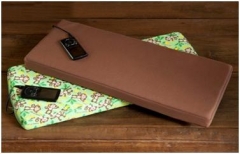
The iLs Pillow delivers processed music through a vibration which is carried by the body (our bones are great conductors). The music travels internally to the bony area surrounding the inner ear, and is audible only by the user. It is used to de-senstitize those with auditory sensitivity, reduce anxiety and improve sleep.
The art and science of keeping children with autism, ADHD and sensory disorders on task.
Showing posts with label Sound Therapy. Show all posts
Thursday, November 1, 2012
Friday, August 17, 2012
Using Ease for Behavior & Flight/Fright
Here is a way to help a child with poor self-regulation (think of a wiggly, inattentive sensory child with or without autism or of a child who is alarmed by loud noise). The type of therapy I'm describing is a lite-version of sound therapy and can be done at home or at school over a period of several weeks. The product is called EASE and is modulated music on a CD (there are a variety of CDs). It is available to parents and therapists at Vision-Audio.com.
Protocol
As a protocol, the child listens to music 2x/day for 20-30 minutes, 5-7 days per week. Separate the 2 daily sessions by 3 hours or more. The volume should be set low - that is, no higher than what is needed for the child to comfortably hear the music.
Try not to use the disks too close to bedtime as the music may be alerting. Use each disk for about 2 weeks. You can rotate the disks in and out of a long-term schedule, or do a few weeks of music and then more later as needed.
Always do a 5-minute test before starting a program. Have the child listen to music for 5 minutes, then wait 24 hours before doing any more. If there are any emotional outbursts, mood changes, or unusual behaviors during that time, do not continue therapy unless you are well-versed in sound therapy and know your way around this.
Do not do sound therapy if the child has a history of seizures, depression, mania, bipolar disorder, or some type of psychosis – including hearing voices.
You will want to buy good headphones. Do not use Bose - they filter out the modulated music sounds. Two good choices are Sony 7506 (about $100) and the relatively childproof Sennheiser HD 500A (about $150). Both are available from on-line sources. Get a good CD Player with random-access play. I like the Sony's that are available for about $25. Putting the player in random-access mode will help keep the music from getting boring. Make sure that Mega Bass is OFF. It is harmful to ears.
By the way, Vision-Audio also has 3-D video games which can help with auditory and visual sensory integration. There is also a very powerful iPod app available to therapists to use with clients.
Protocol
As a protocol, the child listens to music 2x/day for 20-30 minutes, 5-7 days per week. Separate the 2 daily sessions by 3 hours or more. The volume should be set low - that is, no higher than what is needed for the child to comfortably hear the music.
Try not to use the disks too close to bedtime as the music may be alerting. Use each disk for about 2 weeks. You can rotate the disks in and out of a long-term schedule, or do a few weeks of music and then more later as needed.
Always do a 5-minute test before starting a program. Have the child listen to music for 5 minutes, then wait 24 hours before doing any more. If there are any emotional outbursts, mood changes, or unusual behaviors during that time, do not continue therapy unless you are well-versed in sound therapy and know your way around this.
Do not do sound therapy if the child has a history of seizures, depression, mania, bipolar disorder, or some type of psychosis – including hearing voices.
Purchasing Equipment
Purchase Ease 1 or 2 for starters and then if it appears to be working, purchase additional disks. Ease 3 is typically used for children with attachment issues. Ease 4 has especially good 3-D auditory enhancement properties. There are many disks available.
You will want to buy good headphones. Do not use Bose - they filter out the modulated music sounds. Two good choices are Sony 7506 (about $100) and the relatively childproof Sennheiser HD 500A (about $150). Both are available from on-line sources. Get a good CD Player with random-access play. I like the Sony's that are available for about $25. Putting the player in random-access mode will help keep the music from getting boring. Make sure that Mega Bass is OFF. It is harmful to ears.
By the way, Vision-Audio also has 3-D video games which can help with auditory and visual sensory integration. There is also a very powerful iPod app available to therapists to use with clients.
Wednesday, November 16, 2011
Therapeutic Listening and Ease
For those of you working with Therapeutic Listening, Vital Links, is now offering the entire Therapeutic Listening music library for $895 on a chip for use on an i-Pod-like device called Sansdisk ($49).
You can optionally purchase EASE for Sandisk - including EASE disks not offered by Vital Links - from visual-audio.com.
Labels:
Auditory,
Intervention,
Sound Therapy,
Therapeutic Listening,
Timing
Thursday, February 7, 2008
Therapeutic Listening
Article
Hall, L. & Case-Smith, J. (2007). The effect of sound-based intervention on children with sensory processing disorders and visual-motor delays. American Journal of Occupational Therapy, 61, 209-215.
Leah Hall conducted a study with 10 children ages 5y 8m - 10y 11m who were diagnosed with sensory processing disorder (they were rated "Definitely different" in 3 or more areas of the Sensory Profile). Children were given home programs of four weeks with a sensory diet followed by 8 weeks of continued sensory diet with Therapeutic Listening. Significant results were found at the end of the first 4 weeks and at the end of the 12 weeks. Children gained an average of 71 points on the Sensory Profile with the biggest gains in the area of auditory processing and behaviors associated with sensory processing. Children with specific issues (such as auditory hyper-sensitivities, tantrums and hyperactivity made significant gains in some of those areas, as well). In addition, significant gains were made in handwriting (as assessed by the Etch program, and visual processing (as assessed by the VMI). Parents noticed large changes in overall behavior included improved attention, social interactions, self awareness, communication and sleep patterns. One child on medication for ADHD was given a reduction in dosage.
Hall, L. & Case-Smith, J. (2007). The effect of sound-based intervention on children with sensory processing disorders and visual-motor delays. American Journal of Occupational Therapy, 61, 209-215.
Leah Hall conducted a study with 10 children ages 5y 8m - 10y 11m who were diagnosed with sensory processing disorder (they were rated "Definitely different" in 3 or more areas of the Sensory Profile). Children were given home programs of four weeks with a sensory diet followed by 8 weeks of continued sensory diet with Therapeutic Listening. Significant results were found at the end of the first 4 weeks and at the end of the 12 weeks. Children gained an average of 71 points on the Sensory Profile with the biggest gains in the area of auditory processing and behaviors associated with sensory processing. Children with specific issues (such as auditory hyper-sensitivities, tantrums and hyperactivity made significant gains in some of those areas, as well). In addition, significant gains were made in handwriting (as assessed by the Etch program, and visual processing (as assessed by the VMI). Parents noticed large changes in overall behavior included improved attention, social interactions, self awareness, communication and sleep patterns. One child on medication for ADHD was given a reduction in dosage.
Labels:
Articles,
Auditory,
Intervention,
Modulation,
Sound Therapy
Subscribe to:
Posts (Atom)
